
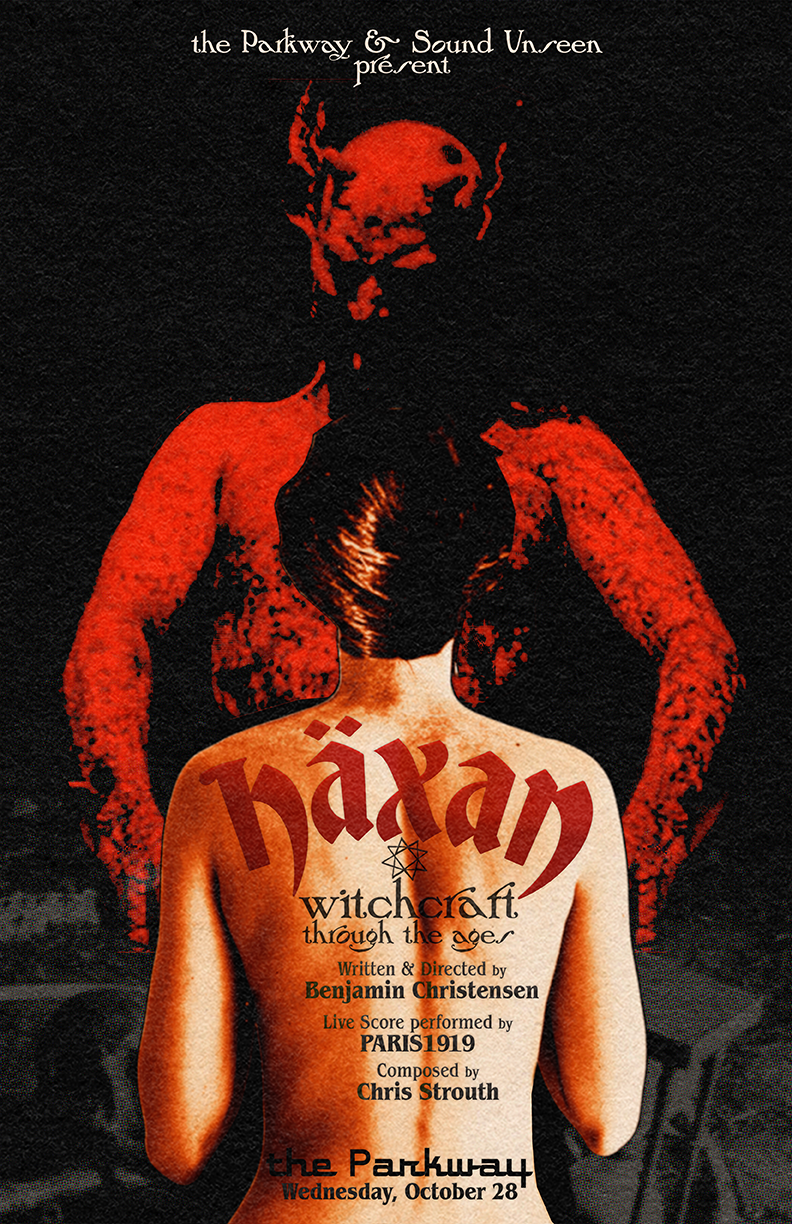
Presented by The Parkway and Sound Unseen
Wednesday, October 28, 2026
6:30 pm Doors // 7:30 pm Music + Film
All Ages
$15 ($20.21 w. taxes/fees) Advance General Admission
$20 ($23 w. taxes/fees) At The Door General Admission
Just in time for Halloween, this popular series pairing iconic silent films with original live score returns with a rare screening of the 1922 Swedish-Danish horror film, Häxan.
The film will be live-scored with a performance featuring new work by Paris1919, the musical collective of celebrated composer Chris Strouth and select Twin Cities musicians, including Natalie Nowytski (a classically-trained vocalist-turned-folk music geek who sings in 50+ languages and 12+ distinct vocal styles), guitarist Kent Militzer, and multi-instrumentalist David J. Russ, and Terrell X D'avion (Carnage The Executioner) one of America's premier beat boxers and a legendary figure of midwestern Hip-Hop. Strouth’s work has been described as “aggressively ambient,” and this will mark his seventh silent film score for the Parkway.
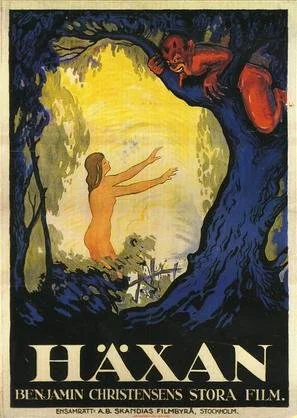
Grave robbing, torture, possessed nuns, and a satanic Sabbath: Benjamin Christensen’s legendary silent film uses a series of dramatic vignettes to explore the scientific hypothesis that the witches of the Middle Ages and early modern era suffered from the same ills as psychiatric patients diagnosed with hysteria in the film's own time. Based partly on Christensen’s own study of the Malleus Maleficarum, a 15th-century German guide for inquisitors, the film is a witches’ brew of the scary, the gross, and the darkly humorous. Praised for its combination of documentary-style and narrative storytelling, as well as its visual imagery, Häxan is considered Christensen's masterpiece, providing audiences with an experience unlike anything else in the history of cinema.
Chris Strouth’s roots as a musician and electronic artist go back to the 1980s, when he got his start as part of the punk art collective around Rifle Sport Gallery in downtown Minneapolis. Since then, he has become a producer, scenemaker, and composer of complex, immersive works, often written for large-scale ensembles or collectives such as Future Perfect Sound System and Paris 1919, with whom he has released four albums and an EP since 2011, most recently 2022's Future Archaeology. The music Strouth creates defies easy categorization and, as with many forms of art, sticking a label on it is perhaps unhelpful — to listeners and to the music itself. Instead, it transcends genre. DJ and electronic musician Kid Koala has praised Strouth's work as "sometimes futuristic, sometimes nostalgic, but always evocative, dwelling in a perfectly focused space between tranquility and chaos. It is the type of music that is a screenwriter's dream."
Paris 1919's music can be jaggedly buzzing and sinister, ethereal and serene, melancholy and stately. There is at times an almost science-fictional quality that seems to blend the mechanical with the organic. There are echoes of the industrial throb of Coil or Throbbing Gristle, Ennio Morricone's film score for The Thing, Enoesque ambience, the Red Room sequences in David Lynch's Twin Peaks, Pink Floyd's more cosmic psychedelia, silent-film innovator Georges Méliès, and more. Still, if a genre label is needed, Strouth's emphasis on digital manipulation and sometimes dark, unsettling atmospherics congenially resonates with both modern neo-classical and ambient drone music, even if it won't fit neatly into any one box.
