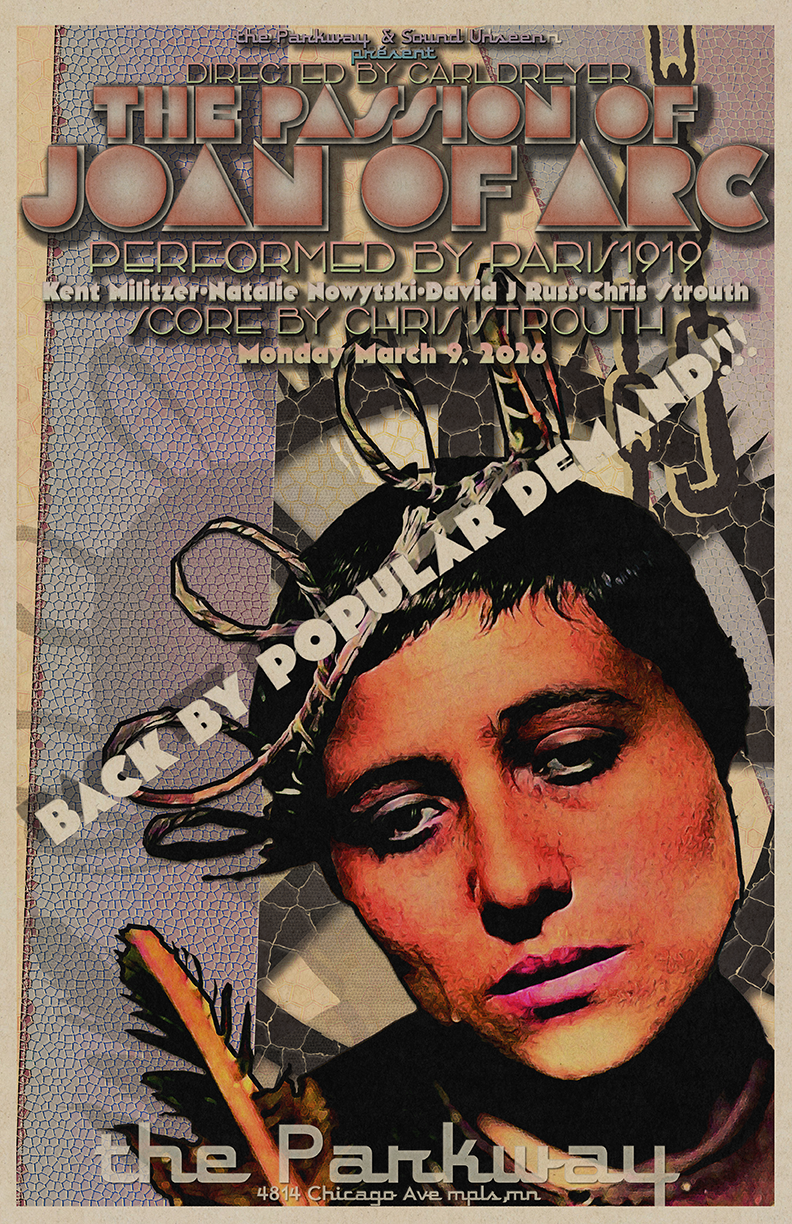
Presented by The Parkway and Sound Unseen
Monday, March 9, 2026
6:30 pm Doors // 7:30 pm Music + Film
All Ages
$15 ($20.21 w. taxes/fees) Advance General Admission
$20 ($23 w. taxes/fees) At The Door General Admission
Ticket purchases are final and non-refundable
Facebook RSVP
An encore performance of last year’s sold-out screening/performance of The Passion of Joan of Arc, the iconic 1928 silent film by acclaimed Danish director Carl Dreyer. The film will be live-scored with a performance featuring new work by Paris 1919, the musical collective of celebrated composer Chris Strouth and select Twin Cities musicians, including Natalie Nowytski (a classically-trained vocalist-turned-folk music geek who sings in 50+ languages including French and who will lead a five-piece women’s choir for this performance, guitarist Kent Militzer, and multi-instrumentalist David J. Russ.
This is a rare opportunity to see this hallmark of cinema which is widely considered a landmark in cinema due to its production design, Dreyer’s direction, and the stunningly powerful performance by lead actress, Renée Jeanne Falconett. As for the score: Strouth’s work has been described as “aggressively ambient,” and this new composition complete with a choir promises to be the perfect accompaniment to this cinematic gem, that is perhaps even more impactful today than upon its release almost one hundred years ago. Strouth notes, “This is a very special event, and one that you will regret to miss!”
Presented in conjunction with Sound Unseen.
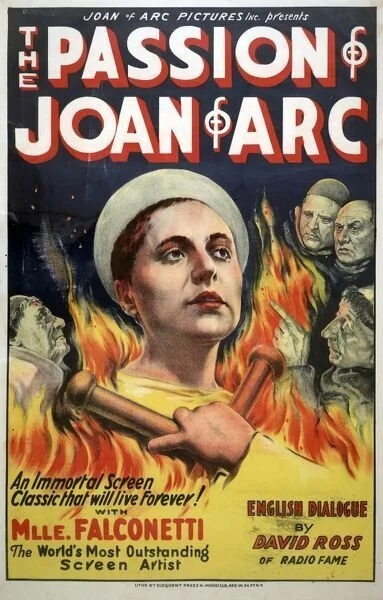
Directed by Carl Theodor Dreyer, this classic film of the silent age tells the story of the doomed but ultimately canonized as a 15th-century teenage warrior. On trial for claiming she'd spoken to God, Jeanne d'Arc (Renée Jeanne Falconetti) is subjected to inhumane treatment and scare tactics at the hands of church court officials (Eugene Silvain, Jean d'Yd). Initially bullied into changing her story, Jeanne eventually opts for what she sees as the truth. Her punishment, a famously brutal execution, earns her perpetual martyrdom.
Chris Strouth’s roots as a musician and electronic artist go back to the 1980s, when he got his start aspart of the punk art collective around Rifle Sport Gallery in downtown Minneapolis. Since then, he has become a producer, scenemaker, and composer of complex, immersive works, often written for large-scale ensembles or collectives such as Future Perfect Sound System and Paris 1919, with whom he has released four albums and an EP since 2011, most recently 2022's Future Archaeology.
The music Strouth creates defies easy categorization and, as with many forms of art, sticking a label on it is perhaps unhelpful — to listeners and to the music itself. Instead, it transcends genre. DJ and electronic musician Kid Koala has praised Strouth's work as "sometimes futuristic, sometimes nostalgic, but always evocative, dwelling in a perfectly focused space between tranquility and chaos. It is the type of music that is a screenwriter's dream."
Paris 1919's music can be jaggedly buzzing and sinister, ethereal and serene, melancholy and stately. There is at times an almost science-fictional quality that seems to blend the mechanical with the organic. There are echoes of the industrial throb of Coil or Throbbing Gristle, Ennio Morricone's film score for The Thing, Enoesque ambience, the Red Room sequences in David Lynch's Twin Peaks, Pink Floyd's more cosmic psychedelia, silent-film innovator Georges Méliès, and more. Still, if a genre label is needed, Strouth's emphasis on digital manipulation and sometimes dark, unsettling atmospherics congenially resonates with both modern neo-classical and ambient drone music, even if it won't fit neatly into any one box.
